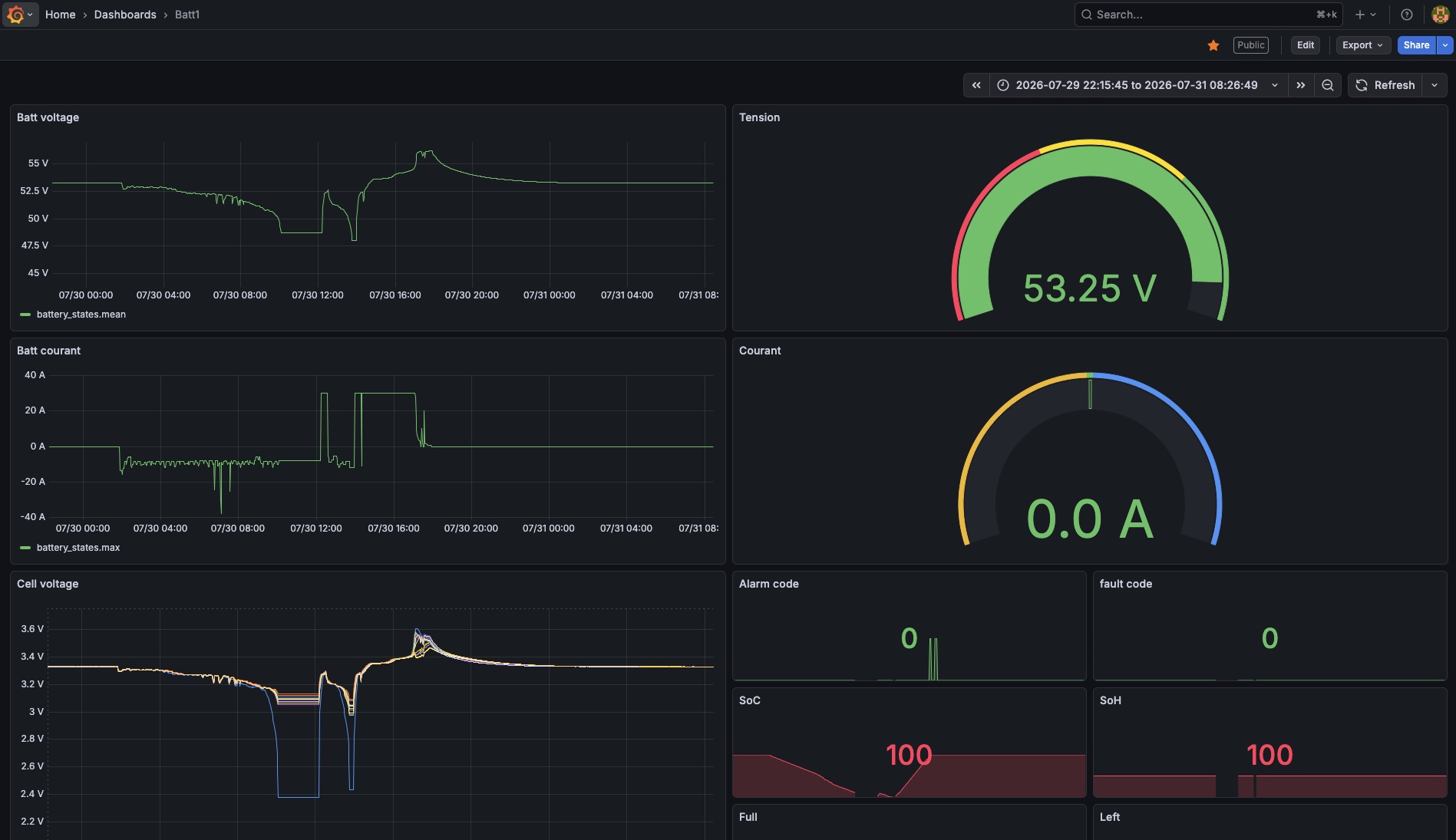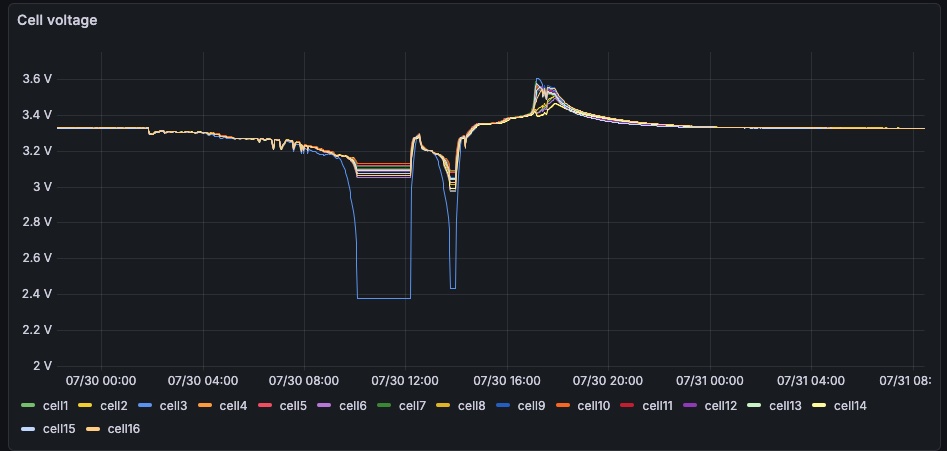
A customer was experiencing a problem with one of their lithium batteries, whose actual capacity was significantly lower than expected. The battery regularly triggered a protection mechanism, interrupting its operation. Understanding the underlying issue was crucial before a diagnosis could be made.
The battery had an RS485 port, which opened the door to potential discoveries. Ultimately, this port, provided by the integrated battery management system (BMS), was exposing internal data via MODBUS.
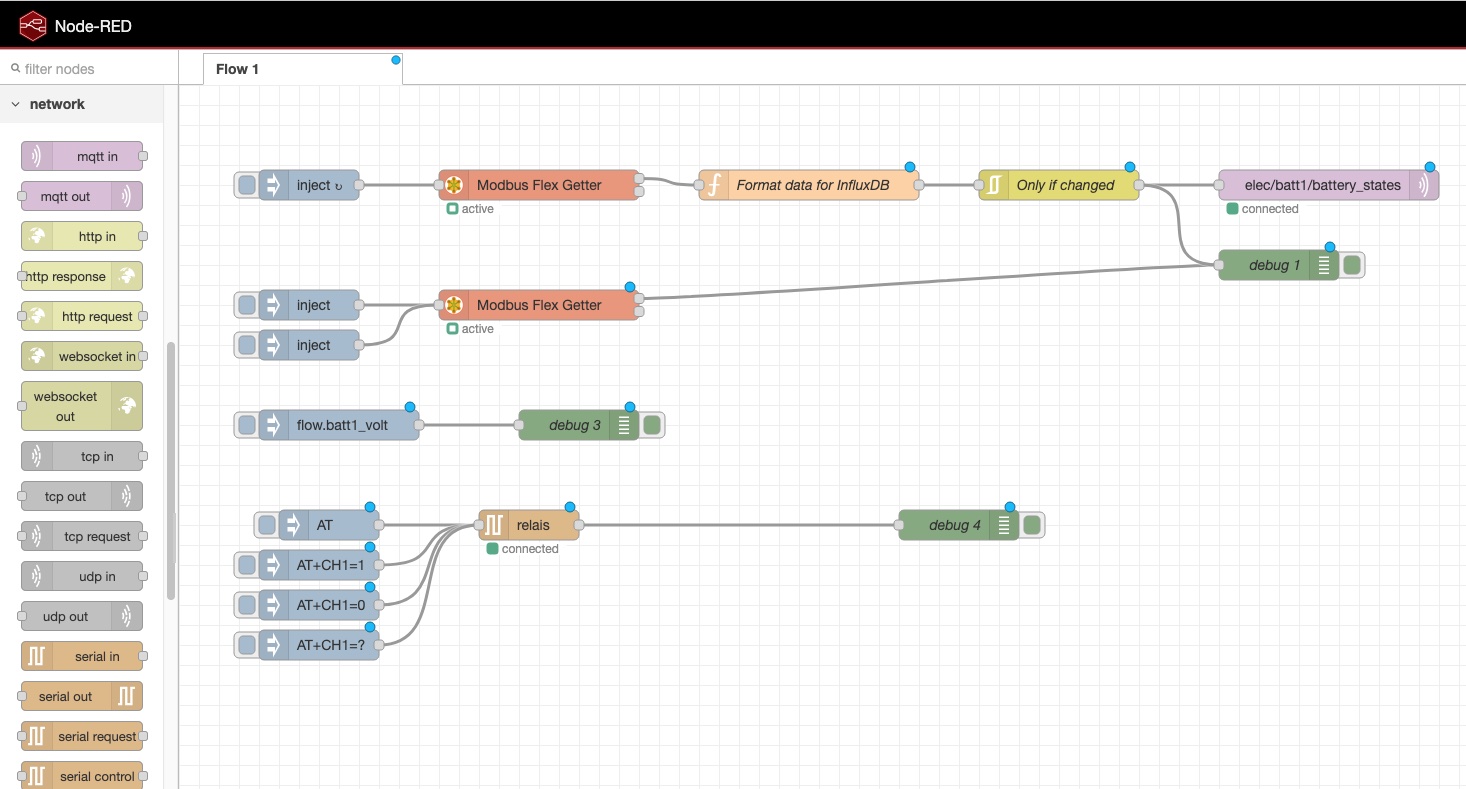
We therefore developed a small monitoring solution to retrieve internal data and store it in time series:
Node-RED to communicate with the BMS and manage MODBUS data
InfluxDB to maintain historical data
Grafana to visualize voltages, currents, stored energy, and their trends over time
The historical data quickly allowed us to identify the problem. One of the 16 cells exhibited very different behavior from the others, and its voltage dropped much more rapidly during discharge.
This cell was the first to reach the low-voltage limit, triggering the BMS protection. The problem was therefore not simply a battery that "lacked capacity," but rather a defective cell that was limiting the use of the entire system.
This project illustrates an approach we favor: monitoring and improving existing equipment rather than replacing it.
With open-source tools and standard protocols, it's possible to add observability to already deployed equipment, centralize its data, and better understand its behavior.
But this approach goes beyond diagnostics. Once equipment is connected and observable, it becomes possible to progressively implement:
- monitoring and alerts
- remote updates
- configuration management
- backup and restore mechanisms
- improved business continuity
The goal is to simplify the operation, maintenance, and evolution of complex systems.
Project category: CA$5,000–10,000